
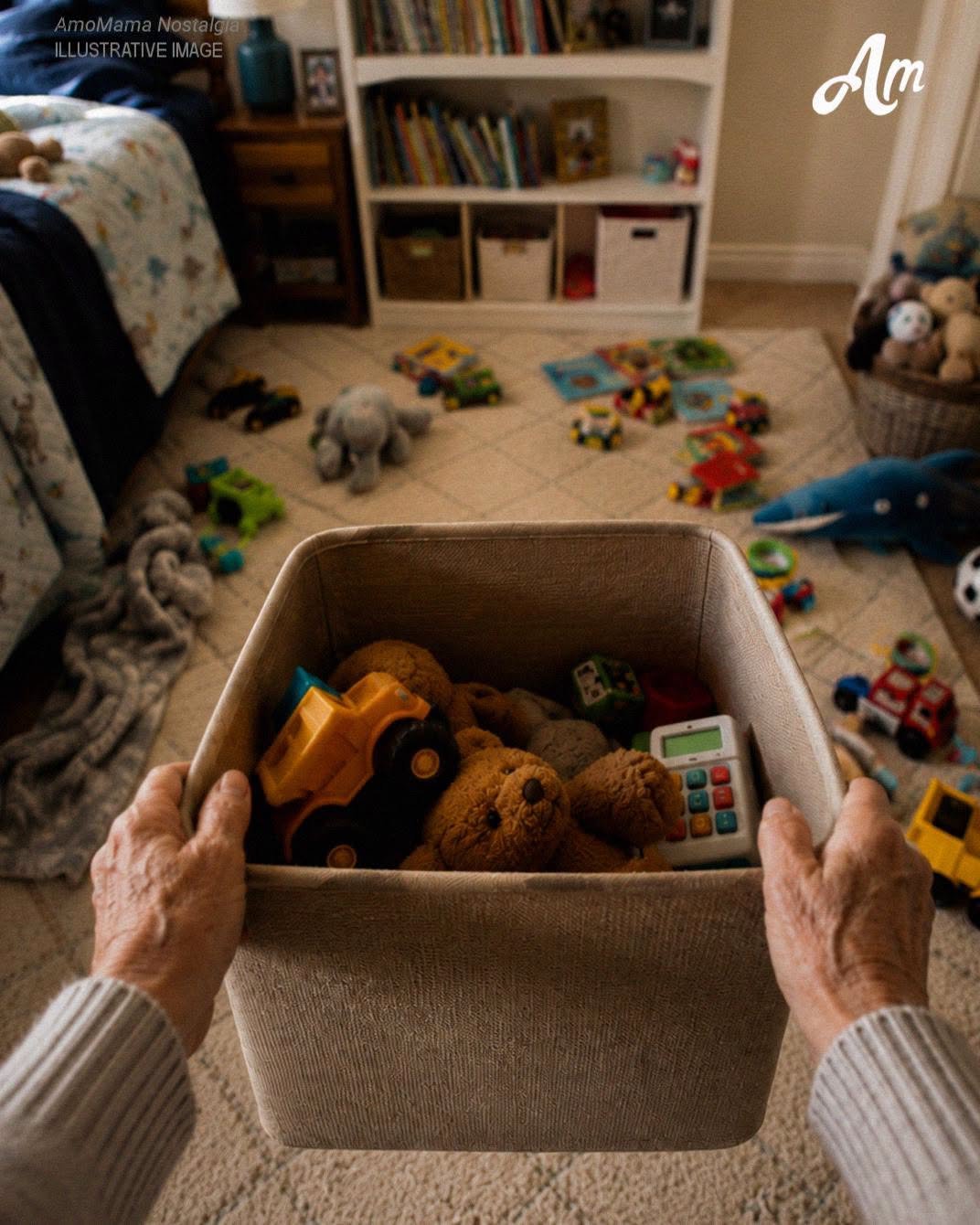
Joan thought her grandson’s messy room was proof that her daughter-in-law was too soft and her son was letting discipline slip. Then she cleaned it behind their backs, found what Dean had been hiding under the bed, and learned the room had never been about mess at all.
For almost a year, my daughter-in-law and I argued about the same thing.
The room of my grandson.
Every time I came over, it looked like a tornado had gone through it.
Toys covered the floor.
Books were stacked in strange places.
Clothes hung over the chair instead of going into the closet.
It drove me crazy.
“I’ll help him clean,” I’d offer.
Every single time, my daughter-in-law Sylvia would stop me.
“Please don’t.”
At first, I thought she was joking.
She wasn’t.
“No one cleans his room but him,” she’d say.
The problem was, he almost never did.
I kept telling her she was teaching him terrible habits.
“He needs to learn responsibility,” I said more than once.
She’d just smile politely and repeat, “Please… just leave it.”
Honestly, I started thinking she was one of those parents who let their kids do whatever they wanted.
My grandson Dean was five.
At five, my son William was already putting his toy trucks back in the basket and hanging his little coat on the hook by the door.
I had raised him that way after his father, Henry, died when William was still young.
I believed in structure because I believed structure kept one moving even after they had faced tough times.
I did not understand then that sometimes structure helps one sweep things under the rug.
I didn’t know that yet.
All I knew was that every time I stepped into Dean’s room, I felt my jaw tighten.
It was a sweet room, really. Blue walls, glow-in-the-dark stars on the ceiling, and tiny sneakers lined up badly near the closet.
There were picture books about dinosaurs, rockets, and bears. But everything was always in the wrong place.
The bed was rarely made.
There were socks under the desk, stuffed animals on the floor, and crayons in odd little piles.
I would stand there and think, This child needs help.
And Sylvia would appear beside me like she had some sixth sense for my disapproval.
“Please leave it. Just stay out of his room,” she’d say, never rude, never angry. Just firm.
William backed her too.
“Mom, we have a system, and it works. Please just leave it alone.”
I almost laughed the first time he said that, looking at the room around us.
“A system?” I repeated. “William, his room looks like a town that has been hit by a tornado.”
He gave me that look grown sons give their mothers when they are trying to stay patient out of love. “We’re handling it.”
To me, “we’re handling it” looked a lot like not handling it at all.
Then one Saturday, they asked me to watch Dean while they ran a few errands.
It wasn’t unusual, but they usually dropped him at my place.
Since I was already at their place, they asked me to stay with him for a few minutes as they did their monthly shopping.
When I stayed with him at my place, he liked building blanket forts in my living room and helping me stir cookie dough, even though more of it ended up on the counter than in the bowl.
He was a good boy. Sweet. Quiet lately, more than he used to be, but still sweet.
That afternoon, he was in the den watching cartoons when William and Sylvia left.
The second their car disappeared down the street, I looked toward the hallway.
I told myself I’d only spend five minutes in his room.
Just pick up a few toys, fold the clothes, and make the bed.
That’s all.
I went in with the best of intentions.
I started with the obvious things.
I arranged a pair of tiny pajama pants draped over the desk chair, three books stacked on the windowsill, and action figures lying on their backs like casualties across the rug.
I set them right, smoothed the blanket on the bed.
And then I noticed how much stuff had been pushed under it.
I got down on one knee and reached for the first thing I could grab. It was a plastic storage box with no lid.
On top of it was a small blanket, soft with wear.
I pulled it out, recognizing it immediately.
The storage box had a cluster of things that would probably make no sense to someone else, but to this family.
A tiny pink stuffed rabbit, more pink toys, a pair of baby socks, a small dress, a faded board book with bite marks on the corner, and a framed photograph.
I picked it up.
My heart started pounding.
It was Dean, younger, maybe four, sitting in a rocking chair and holding his baby sister Darlene in his lap.
He was grinning so hard his whole face had gone round with it.
Darlene was reaching toward his chin with that unfocused baby delight only very small children have.
Under the picture was a small white hospital bracelet with Darlene’s name.
The room suddenly felt too quiet.
Darlene had died over a year earlier.
She had been two years old.
I knew that, of course. How sickly she had been until she died. I had gone to the funeral.
I had told people life was cruel and unfair and that the Lord had His reasons.
I said this because those were the things people say when they do not know what to say in the face of devastation.
Most of Darlene’s things were now stored in the garage.
But I had never known any of this was here.
Why would Dean keep his late sister’s things under his bed?
Why would William and Sylvia let him?
Before I could make sense of it, I heard the front door open.
They were back much earlier than I expected.
I stood up too fast, the photograph still in my hand.
I returned everything to the plastic box, carried it, and started walking out of the room.
My knees complained, and my heart did worse, but I needed answers.
Sylvia appeared in the doorway before I even stepped out.
She looked at me, studied the tidied-up room, and then focused on what I was holding.
All the color drained from her face.
For a second, neither of us said a word.
Then she whispered, “What have you done?”
I opened my mouth, but nothing useful came out.
Before I could answer, she covered her face with both hands. When she looked back at me, tears were already running down her cheeks.
“I begged you not to touch his room.”
I glanced toward the hallway and realized Dean was still in the den, humming softly to himself at the television, unaware the world had just split open in the bedroom.
Sylvia took one shaky breath and lowered her voice.
“What are all these? Why does Dean have his late sister’s things under his bed like a shrine?”
Sylvia looked unwilling to reply, but then she blurted out, “Your son begged me not to tell you.”
Something inside me went cold.
“What are you talking about?”
She leaned against the doorframe like she needed it to stay standing.
For a long moment, she said nothing. Then she looked at the items in the plastic box. The rabbit, the bracelet, the picture in my hand, and her face crumpled.
“This,” she said. “This is why. You never let anything go and are always interfering.”
“What are you talking about?” I asked, genuinely confused.
She came into the room and gently took the box from me, holding it to her chest for a second before setting it on the bed.
“When Darlene died,” she said quietly, “Dean was the one who found her.”
I think I actually stopped breathing.
“What?”
Sylvia nodded once, tears still slipping down her face. “He used to wake up before us and go into her room to play beside her crib. He loved her that much. Every morning, Joan. Every single morning.”
Her voice broke. “By the time she started becoming sick, he would wake up even earlier, and just play beside her crib, whether she was awake or not.”
I remembered how sad Dean had looked when we told him that her sister had a rare genetic mutation affecting her heart.
We told him in a language he could understand, and he never stopped crying.
Doctors had discovered the mutation after she started having breathing difficulties and her skin turned blue.
They were too late in their diagnosis, and nothing could be done. She was simply receiving hospice care.
Sylvia then shared what she and my son had never told me.
“The morning Darlene died, I woke up because I heard Dean crying. Not loud. Just… this awful little sound,” Sylvia said amidst tears.
“The previous night, the hospice nurse had told us that she was doing okay given the circumstances. She assured us we still had more time with her.”
I put a hand over my mouth.
“It turns out she was wrong. I found Dean holding her hand through the crib rails, saying her name as he cried. I can never forget that scene. I never even talk about it because it is too painful,” Sylvia explained.
Darlene had died in her sleep.
One moment, the hospice nurse thought she had time; the next, a catastrophe took place that no one could understand fast enough to stop.
I knew all that, except that Dean was the first to realize that Darlene was gone. He was only barely four at the time.
Sylvia kept talking because once grief starts moving, it often refuses to stop at dignity.
“He has never been the same since,” she said.
“He stopped cleaning his room after that. He started carrying her things into his room a little at a time. First one toy, then a book, then the baby socks she used to kick off.”
I looked around the room, and suddenly I understood the mess.
“He hides them under the bed because that feels safe to him. Some nights he sleeps half hanging off the mattress because he’s dragged those boxes close again.”
The room had become the place where he mourned his sister.
Each item of hers a reminder of Darlene.
This was his sanctuary. A place that Dean didn’t need one to disturb.
“We took him to a therapist,” Sylvia said. “She told us not to force order on him right now. Not to make his room another place where he’s told how to grieve. She said the room is the one place he still feels in control of what he lost.”
I sat down hard on the edge of the bed.
“No one cleans his room but him.”
“Please leave it.”
The words came back to me one by one, and each one felt like a stone.
I whispered, “Why didn’t William tell me?”
Sylvia laughed once through her tears, and there was no humor in it.
“Because he remembered what happened when his dad, Henry, died.”
I looked up at her for an explanation.
She wiped her face and said gently, “He told me when his father died, you packed away all Henry’s things within the week.”
The room blurred.
“You stopped saying his name because you thought it would make the pain worse. You told William not to cry at dinner because he had to be strong. You told him life goes on.”
I heard my own voice from years ago, brisk and frightened and sure of itself.
“We have to be strong.”
“Crying won’t bring him back.”
“Put those things away now.”
I had called it survival.
William had apparently called it something else.
“William said that a week after his father’s death. It was like William never existed.”
I didn’t know what to say. I thought that was the appropriate way to move on. Forget.
That’s why I never bring up Darlene. Once someone dies, I believe all we can do is forget.
The remembering, I learned, hurts so much.
“William never forgot his dad like you did; he spent years trying to grieve in private,” Sylvia said.
“He told me he still cries because he can’t remember his father’s voice or memories. He wasn’t allowed to talk about him enough when he was little, so he remembers very little.”
Sylvia looked at me with exhausted sadness, not cruelty. “He didn’t want that for Dean.”
I had to grip the blanket to keep my hands from shaking.
“He said we shouldn’t tell you about Dean, his room, and the plastic box, because you’d just force your way of grieving on our son and us.”
All those years, I had told myself I did what I had to do after Henry died. I was a widow with a young son, bills, and people waiting to see if I would fall apart.
So I did not fall apart. I built rules instead.
Rules that said we had to give away my husband’s things. William had to stop talking about his dad all the time.
I had never once asked what those rules cost my child.
From the hallway came the sound of cartoon laughter, bright and foolish and innocent.
I looked down at the little pink rabbit on the floor.
“So the room…” I said, but couldn’t finish.
Sylvia nodded.
“The room was never the real problem.”
I started crying then.
The kind of crying that pulled up shame from places you thought had already gone numb.
“I’m sorry,” I whispered. “Oh God, Sylvia, I’m so sorry.”
She sat beside me, tired beyond anger.
“I know you love him,” she said. “But your way of grieving should not be everyone’s standard.”
That sentence cut cleanly because it was true.
“You should also just let us parent the way we want,” Sylvia added. “Listen and respect what we want. Most times, your interference just makes us pull further away from you.”
I nodded, reaching for Sylvia’s hands and squeezing them tenderly.
A few minutes later, William appeared in the doorway. He must have sensed something was wrong from the silence.
He looked from Sylvia’s face to mine to the things on the bed.
Then he closed his eyes.
“Mom.” What did you do?
I stood up so fast I nearly tripped on some toys still on the floor.
“I wasn’t trying to—”
“Interfere as you always do?” he asked quietly. “That’s why I asked Sylvia not to tell you. Because once you decide you’re helping, you don’t always notice when you’ve crossed the line.”
I deserved that too.
I said, “I didn’t know.”
“No,” he said. “You didn’t. Because I didn’t let you know. Because when Dad died, you didn’t let me grieve the way I needed to, and I wasn’t going to let that happen to Dean.”
The truth I had apparently been earning for decades finally came from my son.
I could have defended myself.
I could have said I was young, overwhelmed, terrified. All of that would have been true.
And none of it would have fixed anything.
So I sat back down and said the only honest thing left.
“I was wrong.”
William looked startled by how fast it came.
I went on because I needed him to know right there and then.
“When Henry died, I thought if I let the grief into the house, it would swallow both of us,” I admitted.
“I thought if I packed up his shirts and kept busy and made you behave like everything could still function, then maybe we’d survive it.”
My throat tightened. “But I never stopped to wonder whether surviving was better than tackling the grief. I know now that it wasn’t enough to just survive.”
William sat in the desk chair, elbows on knees, suddenly looking much younger than his 40 years.
“You didn’t even say his name,” he said.
I closed my eyes. He was right.
Henry became the past.
A set of practical references instead of the man I had loved. I had thought speaking of him less might hurt less.
Instead, I had erased him in front of the person who needed him remembered most.
“I’m sorry,” I said again, looking at my son now. “Not just for today. For then.”
William’s face changed.
He was still hurt, still cautious, but something in him softened around the edges.
Sylvia reached over and took his hand.
Then Dean came barreling down the hallway in dinosaur socks, asking if anyone wanted to see the tower he built out of couch cushions.
The four of us looked at one another through tears, wreckage, and all the truths that had finally come loose.
Sylvia stood first.
“I’ll go.”
Before she left the room, she turned to me and said quietly, “If you really want to help him, don’t touch anything in here again. Please, just listen to us.”
“I won’t,” I said. And I meant it.
That evening, after Dean had gone to bed, William and I sat on the back porch alone.
The air smelled like cut grass and rain that never quite arrived.
For a while, we just listened to crickets.
Then I said, “What do I do now?”
My son looked out into the yard for so long that I thought he might not answer.
Finally, he said, “If you want… You can tell me about Dad.”
“Okay,” I said.
He kept his eyes on the dark. “Tell me something real. Something you never told me because you thought it would make things harder.”
So I did.
I told him how Henry used to sing badly on purpose while fixing the sink just to make me laugh. How he hated olives with personal conviction.
How he once drove 20 miles at midnight because I was pregnant and wanted peaches.
How he cried when William was born and pretended he had something in his eye when the nurse caught him.
I told him everything I could remember before fear had turned memory into a locked drawer.
William cried.
So did I.
It was, I think, the first honest conversation we had ever had about Henry.
After that, I stopped interfering.
Truly stopped.
Not in the performative way people do when they want credit for self-restraint.
I stopped because, for the first time, I understood that Dean’s room was not a housekeeping issue.
It was a five-year-old boy’s way of dealing with grief.
A year passed.
Grief, I learned, does not leave on schedule. But it does change shape when given room.
One afternoon, I came over and found Dean proudly putting books back on his shelf.
Not because anyone told him to.
Just because he was ready.
His room was still not neat by my old standards, but it was no longer a storm zone either.
There was a section in his closet now, low enough for his own hands to reach, where a small basket held Darlene’s rabbit, the board book, the baby socks, and the photograph.
It was no longer hidden.
Sylvia smiled when she saw me notice it.
“The therapist says he’s moving into acceptance,” she said softly. “He talks about her without crying most days.”
He’d say things like, “When I’m big, I’ll tell my kids I had a sister.”
William changed too. Or maybe he was finally changing back into the parts of himself grief had bent.
He laughed more.
He and Sylvia looked at each other with that tired, battle-tested tenderness people earn only by surviving the worst together.
Their daughter’s death had not broken them apart.
Their son’s grief had not disappeared into silence.
They had done for him what I had not known how to do for William.
They had stayed.
They had let sorrow live in the house without making it shameful.
One evening, long after all of this, William came by my place alone.
We sat at my kitchen table with coffee going cold between us.
He looked around at the framed photographs on my sideboard. Henry was there now. Not hidden in an album that was packed away.
“Thank you, Mom,” he said softly.
I smiled a little. “I’m trying.”
He nodded.
Then, after a pause, he said, “I know you did the best you could.”
I started crying immediately, which was humiliating, but there was no stopping it.
“No,” I said. “I did what I thought was necessary. That’s not always the same thing.”
He reached across the table and squeezed my hand.
Maybe that was forgiveness. Maybe just understanding.
At my age, I have learned not to demand more than any person is willing to give.
What I know is this:
I thought the problem was a messy room.
I thought the issue was discipline, responsibility, bad habits, and weak parenting.
I was wrong.
The room signified my grandson’s grief and memory of his sister.
The room was a little boy trying to keep his sister close in the only way that still made sense to him.
And beneath that, deeper than I wanted to look, was another truth:
My grandson’s room forced me to finally see what I had done to my own son when his father died.
As months went by, Dean made his bed on his own for the first time.
I was proud of him.
Because for once in my life, I understood that the goal had never been to make grief disappear.
It was to make sure the people carrying grief were given the grace to do so in the way they knew best, and that they never had to bear its weight alone.
What would break you more: Finding your grandson’s hidden box of memories, or realizing your own son had spent years grieving his father in silence because of how you handled loss?
If you enjoyed this story, here is another one you might like: I thought my daughter-in-law was being controlling about the baby’s food because she wanted everything done perfectly. Then I saw her adding the same white powder to every meal, sent a photo to my pharmacist, and learned she had been hiding something far more frightening than simple overprotection.

My Sister Threw Our Grandma a Birthday Party, but Demanded Grandma Pay for It – Karma Was Instant
I knew my sister was up to something the moment she offered to plan our grandma’s 70th birthday dinner, but I never imagined she’d turn it into a public humiliation.
Pour connaître toutes les étapes de la recette, veuillez vous rendre à la page suivante ou ouvrir le bouton (>) et n'oubliez pas de PARTAGER avec vos amis Facebook.
